Free printables · no email needed
Printable 30-day challenges
A tracker for 30 mornings up at the first alarm, and a gentle squat plan to go with it. Print one, pin it where you'll be once you're up, and tick a box a day.
Download the printables
-
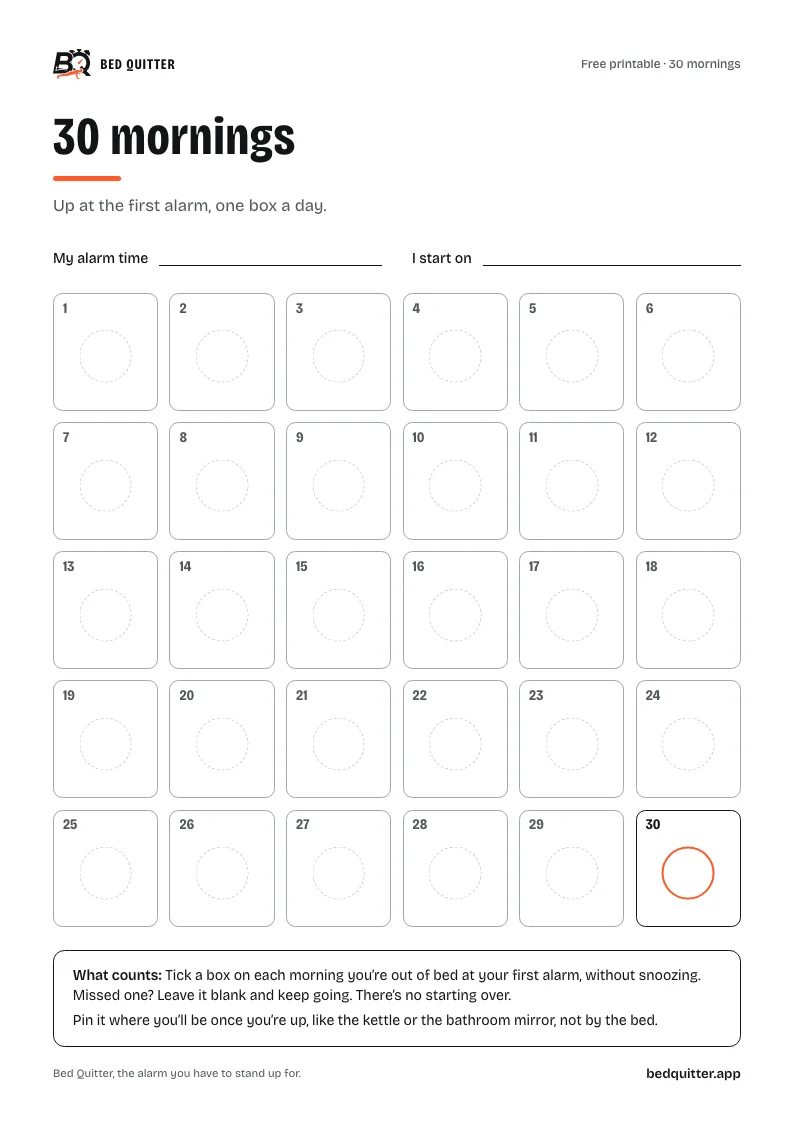
30 mornings tracker
Tick a box each morning you get up at the first alarm.
-
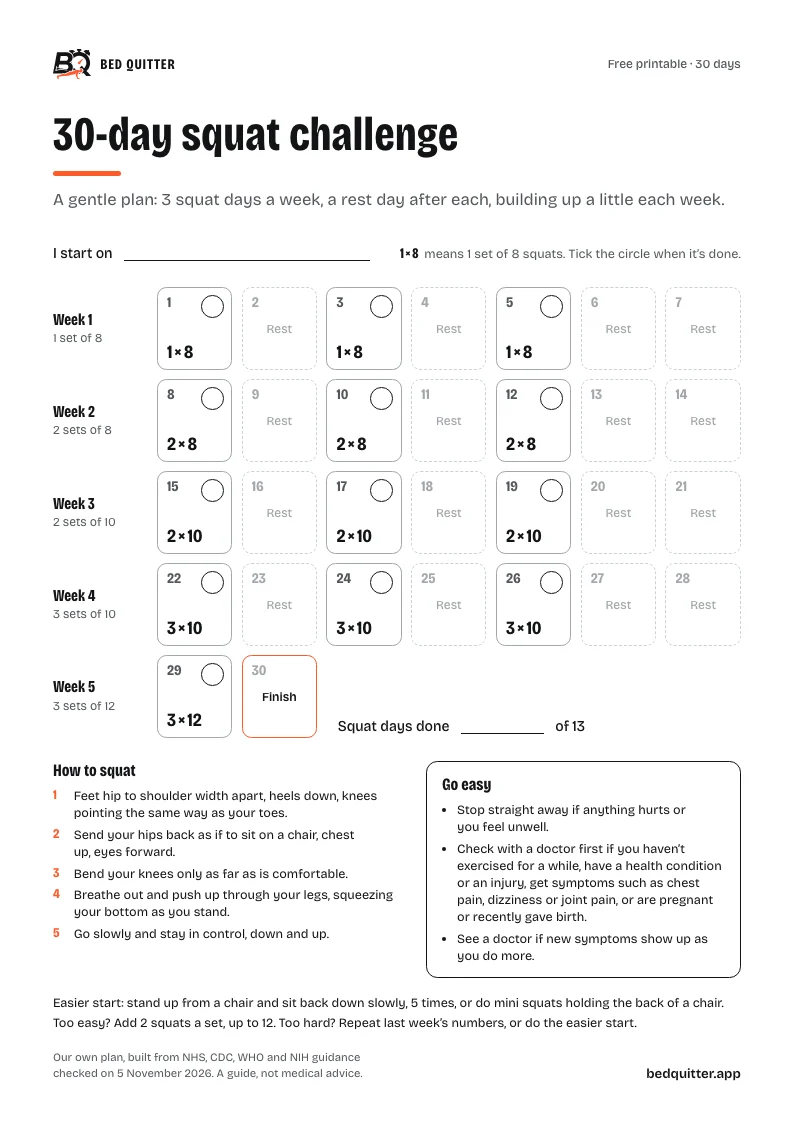
30-day squat challenge
A gentle plan: 3 squat days a week, with rest days between.
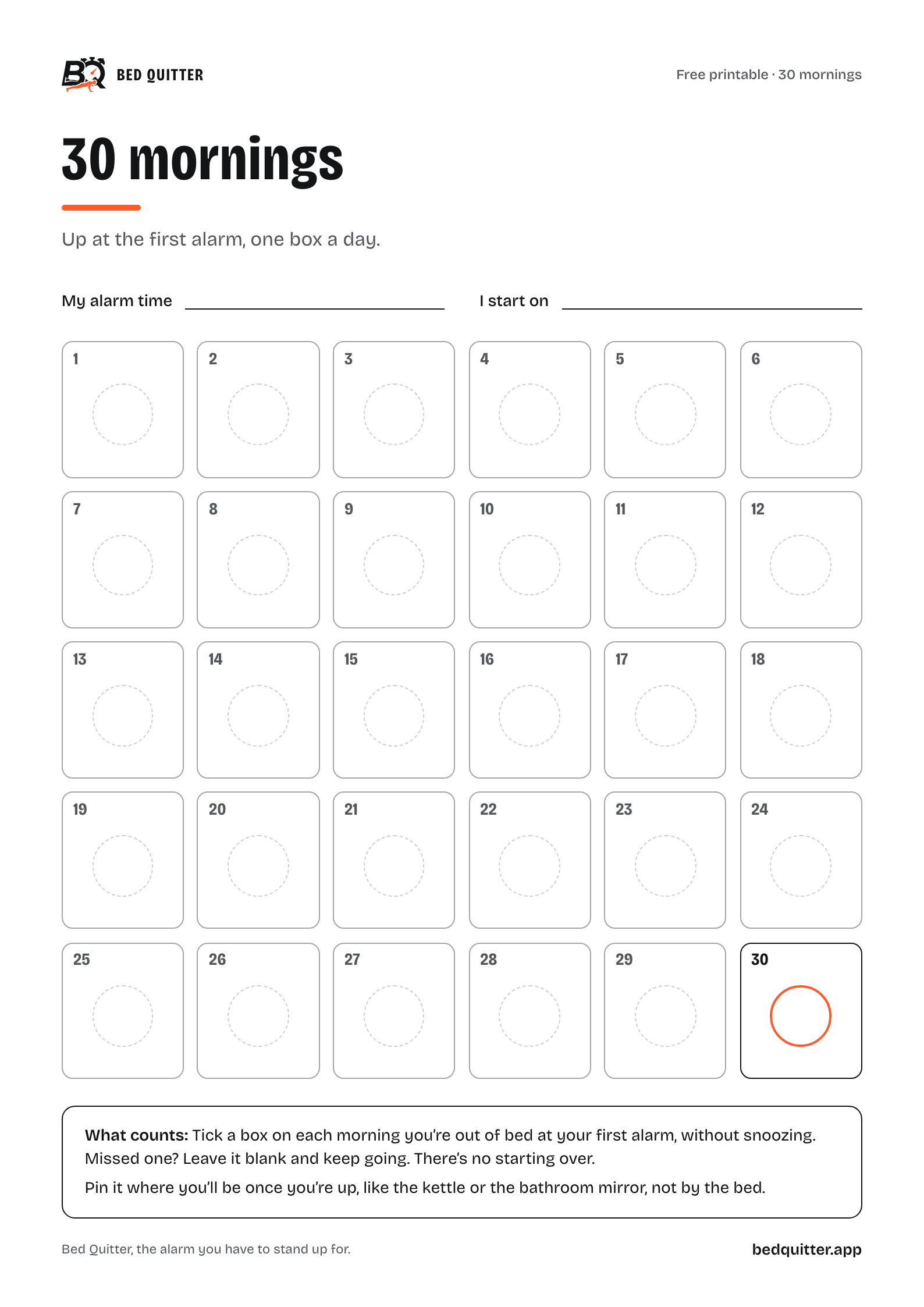
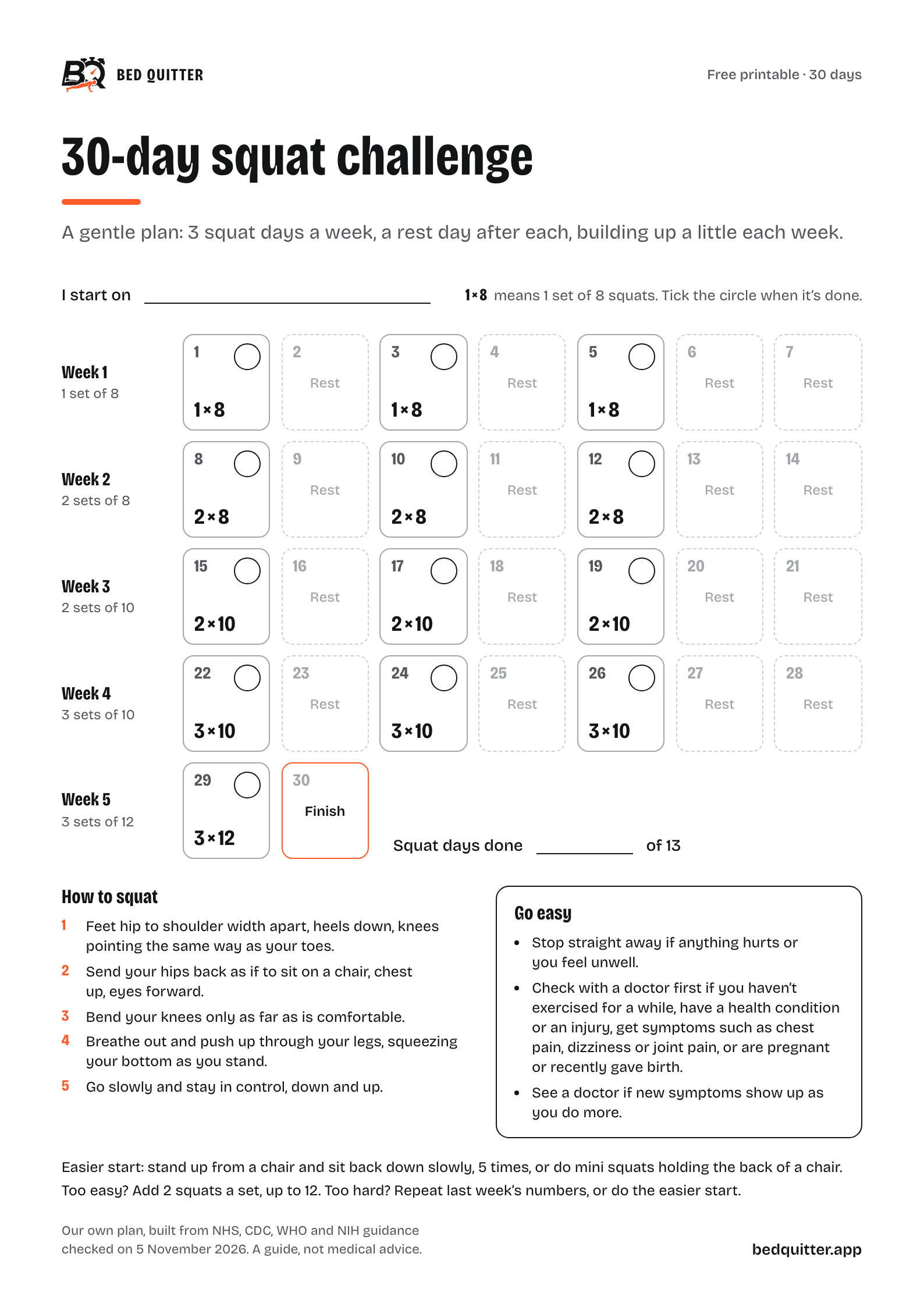
Print at 100%, or Actual size. The image is the A4 sheet, for a phone or tablet.
- No email needed
- Both download straight away. The emails below are separate and optional.
- Easy on ink
- White paper, dark ink and a touch of orange.
- Start any day
- Numbered boxes, not dates. Or start with the January challenge on Friday 1 January 2027.
How the 30 mornings tracker works
Write your alarm time and the day you start at the top. Each morning you're out of bed at your first alarm, without snoozing, tick that day's box.
Missed one? Leave it blank and keep going: there's no starting over. 29 ticks out of 30 is still 29 mornings.
| Pin it up | Where you'll be once you're up, like the kettle or the mirror, not by the bed. |
| Set it for real | Pick the time you actually need to be up, and write it at the top. |
| Make it a walk | Put the phone where you have to stand up to reach it. |
| Tick it first | Before the kettle boils, so the tick is part of getting up. |
The January challenge
Doing it in January?
The challenge starts on Friday 1 January 2027: 30 mornings up at the first alarm, ticked off on the tracker. Starting late is fine, as the boxes are numbered, not dated.
You're in: 4 short emails during the challenge, and nothing else. Reply to any of them to stop.
The 30-day squat plan
There's no official 30-day squat challenge. This plan is ours, built from published guidance on strength exercise (listed below): 13 squat days, 3 a week and never two in a row, starting small and building up a little each week.
| Week | Squat days | Each squat day |
|---|---|---|
| Week 1 | Days 1, 3 and 5 | 1 set of 8 |
| Week 2 | Days 8, 10 and 12 | 2 sets of 8 |
| Week 3 | Days 15, 17 and 19 | 2 sets of 10 |
| Week 4 | Days 22, 24 and 26 | 3 sets of 10 |
| Week 5 | Day 29 | 3 sets of 12 |
The days between are rest days, and so is day 30.
Easier start: stand up from a chair and sit back down slowly, 5 times, or do mini squats holding the back of a chair. Too easy? Add 2 squats a set, up to 12. Too hard? Repeat last week's numbers, or do the easier start.
How to squat
- Feet hip to shoulder width apart, heels down, knees pointing the same way as your toes.
- Send your hips back as if to sit on a chair, chest up, eyes forward.
- Bend your knees only as far as is comfortable.
- Breathe out and push up through your legs, squeezing your bottom as you stand.
- Go slowly and stay in control, down and up.
When to stop, or ask first
- Stop straight away if anything hurts or you feel unwell.
- Check with a doctor first if you haven't exercised for a while, have a health condition or an injury, get symptoms such as chest pain, dizziness or joint pain, or are pregnant or recently gave birth.
- See a doctor if new symptoms show up as you do more.
Compared with published guidance
| How often | Strength exercise on at least 2 days a week (NHS, CDC, WHO). This plan: 3 squat days a week. |
| How many | 8 to 12 repetitions make a set. At least 2 sets, or 3 for more benefit (NHS); at least 1 set, or 2 or 3 for more benefit (CDC). This plan: 1 set of 8, building to 3 sets of 12. |
| Rest | Don't work the same muscles two days in a row (NIH's National Institute on Aging). This plan: a rest day after every squat day. |
| Building up | Start gradually and build up over weeks (NHS), a little each week (US guidelines). This plan: one small step a week. |
| Popular challenges | Some climb to 200 or more squats a day, with 3 squat days in a row between rest days: one goes from 50 to 250 a day, another from 50 to 225. |
Checked on against these sources. A guide, not medical advice.
- NHS: Physical activity guidelines for adults aged 19 to 64
- NHS: How to improve strength and flexibility
- NHS: Strength exercises (sit-to-stand and mini squats)
- NHS: Strength and Flex exercise plan, safety
- CDC: What counts as muscle-strengthening activity for adults
- WHO 2020 guidelines on physical activity (Bull and others, British Journal of Sports Medicine)
- Physical Activity Guidelines for Americans, 2nd edition (PDF)
- NIH's National Institute on Aging: Exercise types and safety
- Chartered Society of Physiotherapy: Lower body strengthening exercises
- APTA ChoosePT: Double leg squat
Questions people ask
Is this squat challenge OK for beginners?
It starts small on purpose: 1 set of 8 squats on 3 days a week, with a rest day after each, building up a little each week, as the NHS and the US guidelines suggest. If a full squat is too much, start by standing up from a chair 5 times. Stop if anything hurts, and check with a doctor first if you haven't exercised for a while or have a health condition.
How many squats a day should I do?
Guidelines don't give a daily number. The NHS suggests strength exercises on at least 2 days a week, 8 to 12 repetitions a set, and at least 2 sets, or 3 for more benefit. This plan has squat days rather than squats every day: 3 a week, ending at 3 sets of 12.
Why not 100 squats a day?
Some popular 30-day challenges climb to 200 or more squats a day, with 3 squat days in a row between rest days. This plan stays with what published guidance describes: sets of 8 to 12, a few days a week, and a rest day between, as the NIH's National Institute on Aging advises. Its biggest day is 36 squats.
What counts as getting up at the first alarm?
A morning counts when you're out of bed at your first alarm, without snoozing. Tick the box once you're up. Missed one? Leave it blank and keep going: there's no starting over.
Which paper size should I print?
US Letter in the US and Canada, A4 almost everywhere else. Print at 100%, or Actual size. The image is the A4 sheet, for a phone or tablet, and prints on either paper with Fit to page.
Do I need to give my email to download them?
No. Both printables download straight away. The January challenge emails are separate, optional, and only for people 18 or older.
When does the January challenge start?
On Friday 1 January 2027. The tracker has numbered boxes, not dates, so you can also start any day you like: write your start date at the top.
From the makers of these printables
Make the first alarm the one you get up for.
Bed Quitter is an alarm that keeps ringing until you get out of bed and move. You pick one of seven moves, your phone's camera counts a few reps, and no photo or video from the camera leaves your phone.
You're on the list. We'll email you once, at launch.
More free tools
Free tool
Will my alarm go off?
Do Not Disturb, silent, a call or low power: see if your alarm will ring tonight.
Free tool
Wake-up time calculator
Any wake-up time, or when to wake if you go to bed now.
Free tool
Snooze cost calculator
How much time a year your snooze button takes, on a receipt to share.